
When it comes to YouTube SEO, two metrics dominate every creator’s analytics dashboard — CTR (Click-Through Rate) and Average View Duration (AVD). But which one actually drives your video’s ranking and visibility on the platform?
In this guide, we’ll break down how each metric works, how they affect YouTube’s recommendation algorithm, and which one you should prioritize for long-term growth in 2026.
💡 If you’re also looking to increase your visibility fast, check our updated guide on the best websites to buy YouTube views in 2026.
What Is CTR on YouTube?
CTR (Click-Through Rate) measures how often people click on your video after seeing it on YouTube.
Formula:
CTR = (Number of Clicks ÷ Number of Impressions) × 100
For example, if your video thumbnail appears 1,000 times and gets 100 clicks, your CTR is 10%.
Why CTR matters:
- High CTR means your thumbnail and title are attracting attention.
- A strong CTR increases your video’s initial exposure in recommendations.
- It’s one of the first signals YouTube uses to test new videos in search and suggested feeds.
Good CTR benchmarks (2026):
- Average: 4–6%
- Strong: 7–10%
- Excellent: 10%+ (usually in small or niche audiences)
What Is Average View Duration (AVD)?
Average View Duration shows how long viewers stay on your video before clicking away.
It’s a direct reflection of audience retention — the longer people watch, the stronger the signal to YouTube that your video satisfies viewers.
Formula:
AVD = Total Watch Time ÷ Total Views
Example: If your video has 10,000 minutes of total watch time from 2,000 views, your AVD is 5 minutes.
Why AVD matters:
- It affects your Watch Time, a major YouTube ranking factor.
- Longer AVD = better audience engagement.
- It determines how often your video appears in Suggested Videos and Home Feed.
How the YouTube Algorithm Balances CTR and AVD
YouTube’s algorithm works like a two-step filter:
- CTR = Attraction
- If viewers click your thumbnail and title, YouTube sees your video as “interesting.”
- High CTR earns your video initial reach and impressions.
- AVD = Satisfaction
- If people continue watching, YouTube knows your content delivers value.
- High AVD drives retention and long-term ranking.
Think of CTR as getting people in the door, and AVD as keeping them in the room.
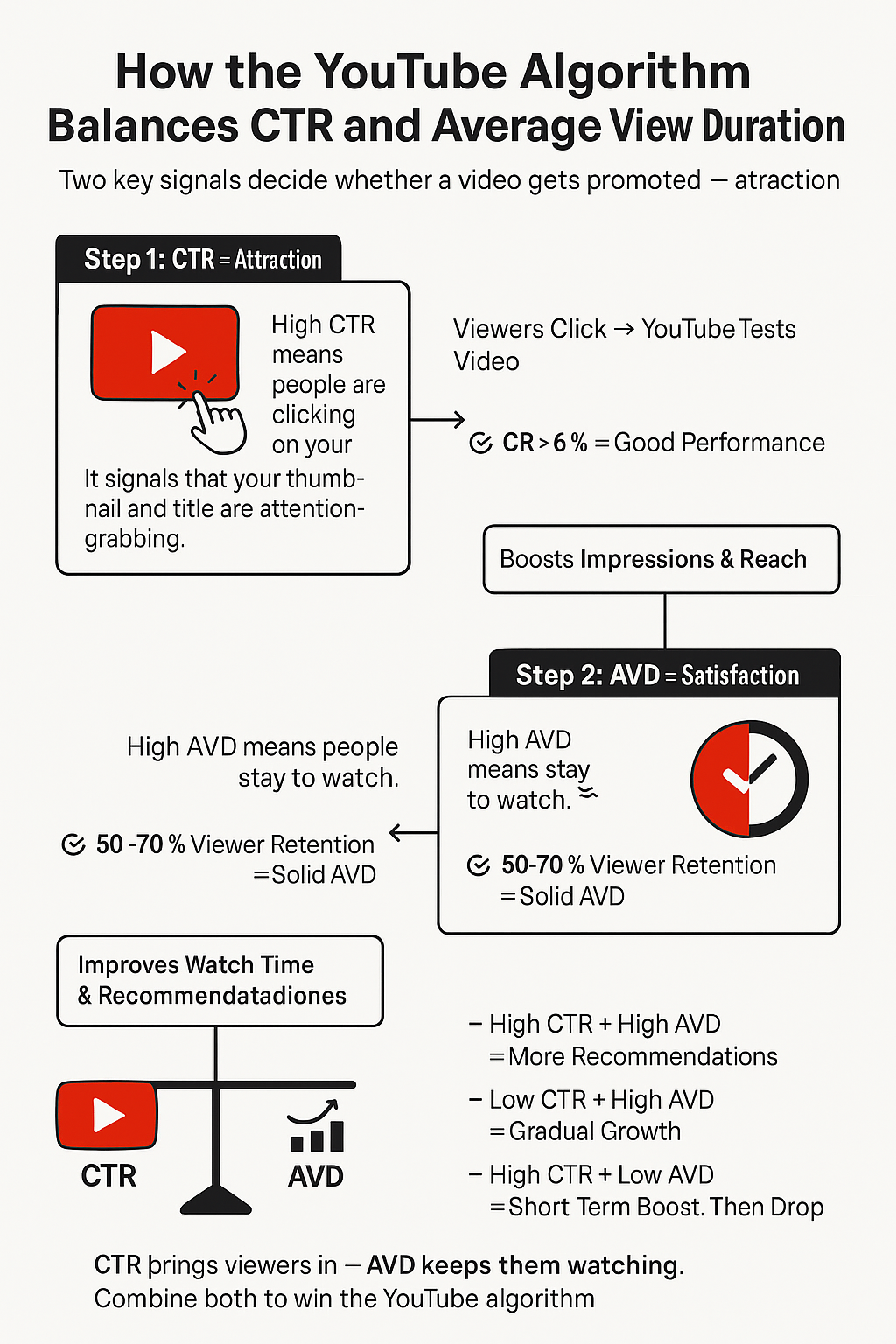
If your CTR is high but AVD is low, YouTube may stop promoting your video — because users clicked but didn’t stay.
If your CTR is low but AVD is high, YouTube may slowly increase exposure over time, testing it with more users.
Which Metric Matters More for Ranking?
In 2026, Average View Duration outweighs CTR in long-term ranking power.
Here’s why:
- YouTube prioritizes Watch Time and session duration — not just clicks.
- The algorithm’s goal is to keep users on the platform longer.
- A video that keeps viewers watching for 5+ minutes contributes more total watch time than a video people abandon after 30 seconds.
However, you can’t ignore CTR, because without clicks, your AVD never gets tested.
The winning formula:
High CTR + High AVD = Maximum algorithm favorability.
How to Improve Both CTR and AVD
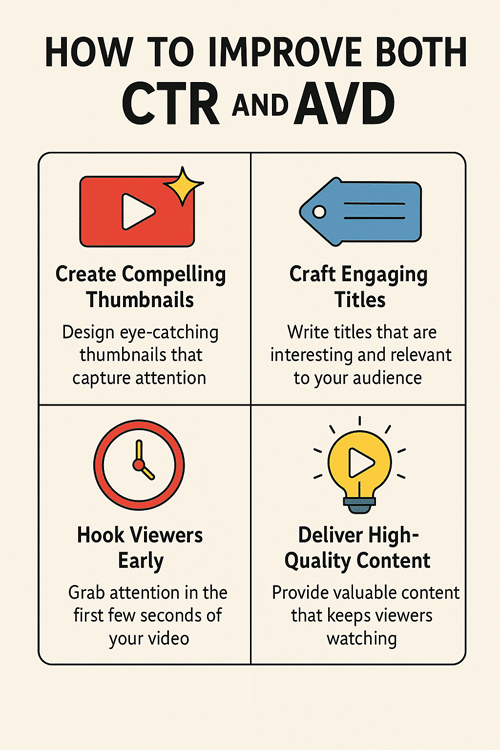
Boost CTR
- Design bold, curiosity-driven thumbnails (clear face, emotion, contrasting colors).
- Use data-backed titles that promise specific results (e.g., “How I Got 10,000 Views in 7 Days”).
- Test variations with YouTube’s Experiment feature in 2026 Studio Analytics.
Boost AVD
- Start videos with strong hooks in the first 10 seconds.
- Remove filler content — every second counts.
- Use pattern interrupts (graphics, zooms, B-roll) to maintain interest.
- Add timestamps and teasers (“Stay until the end — I’ll reveal…”).
Final Verdict: Focus on the Full Viewer Journey
While CTR gets your video seen, Average View Duration keeps it ranking.
Creators who master both metrics can dominate YouTube’s recommendation system in 2026.
Key takeaway:
Optimize your thumbnail and title to attract clicks — but craft your content to hold attention. The combination of high CTR and high AVD will fuel your YouTube growth faster than either metric alone.
